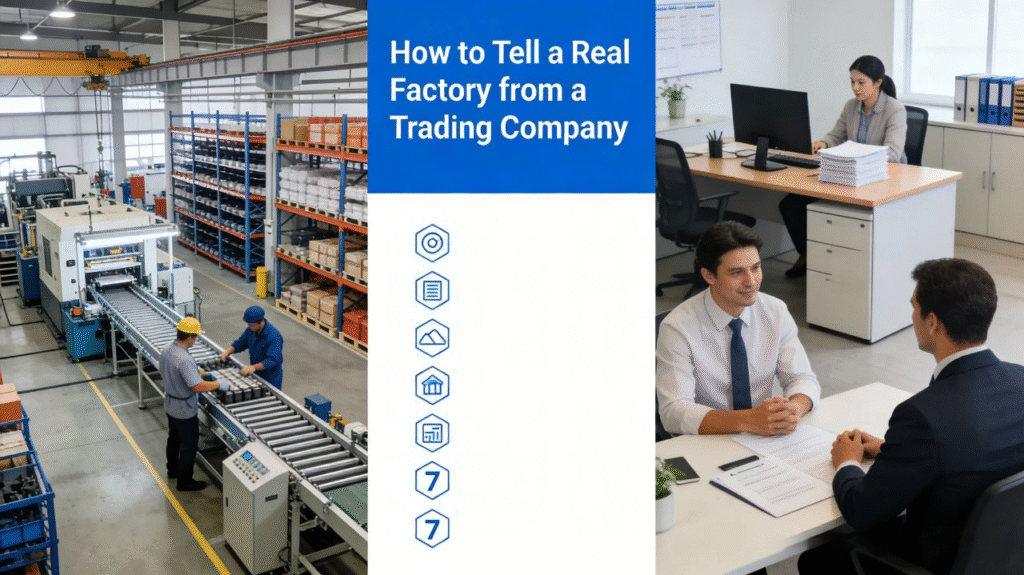
Most overseas drinkware importers have one common goal: to work directly with a real factory, not a trading company.
They assume this means lower prices, better quality control, and fewer middlemen. But the reality is simple: 80% of importers end up working with trading companies — and for good reason.
The problem isn’t that trading companies are “bad.” It’s that you need to know who you’re working with to make the right choice for your business.
Today, I’m sharing 9 practical, verifiable ways to tell a real drinkware factory apart from a trading company. No guesswork, no excuses — just clear, actionable steps.
1. Business License Check
Real Factory:A genuine factory’s business license will clearly include keywords like “production,” “manufacturing,” or “processing” in its scope of business. Most importantly, the legal owner of the supplier you’re communicating with must match the owner of the factory — if they’re different, it’s almost certainly a trading company.
Trading Company:A trading company’s business license will focus on “trade,” “import and export,” or “sales” — no mention of production or manufacturing. The owner of the trading company will not be the same as the owner of the factory they claim to represent.
2. Production Address Verification
Real Factory:Nearly all real drinkware factories are located in industrial zones, towns, or suburban areas — not in high-end downtown office buildings. They have large workshops, production lines, and raw material warehouses that are visible in photos or videos.
Trading Company:Trading companies are usually based in downtown office buildings. They may have a small sample room to display products, but they will never have their own production lines or workshops.
3. Factory Audit Reports
Real Factory:Genuine factories hold valid third-party audit reports such as BSCI, Sedex, or ISO. The name on the audit report will be exactly the same as the name of the supplier you’re working with — this is non-negotiable for real manufacturers.
Trading Company:Trading companies do not have their own independent audit reports. They may borrow reports from their partner factories, but the name on the report will not match the trading company’s name.
4. Staff Structure
Real Factory:A factory’s team is dominated by production-related personnel, including technical workers, production line workers, quality inspectors, and equipment maintenance staff. You’ll often hear them mention production shifts, equipment maintenance, or raw material inventory.
Trading Company:Trading companies mainly employ commercial staff, such as sales representatives, purchasers, merchandisers, and customer service agents. They rarely talk about production details and focus more on quotes, orders, and logistics.
5. On-Site Verifiability
Real Factory:A genuine drinkware factory will readily provide:
Live video feeds of the production line or on-site factory tours (you can ask for a real-time video call to see the workshop)
Close-up photos of equipment serial numbers and nameplates (e.g., stamping presses, injection molding machines used for stainless steel tumblers)
Full walkthroughs showing the complete production flow: from raw material storage (e.g., recycled stainless steel sheets) → forming → polishing → coating → quality inspection → finished goods packaging
Trading Company:Trading companies typically only share photos of their sample rooms or office spaces. They will:
Refuse to provide full production videos or live tours
Use excuses like “The factory doesn’t allow filming” or “Production processes are confidential”
Never show you the end-to-end manufacturing workflow — only finished products or sample displays
6. Mold & Equipment Ownership
Real Factory:Factories own their production assets and will prove it by:
Sharing photos or videos of their mold library (where custom molds for drinkware are stored)
Providing mold numbers, purchase receipts, or maintenance records for your specific product (e.g., a custom tumbler mold)
Allowing direct adjustments to molds or production processes (e.g., changing the wall thickness of a stainless steel bottle, modifying the matte coating finish)
Trading Company:Trading companies have no ownership of production tools:
They rely entirely on partner factories’ existing molds — they cannot create new molds on their own
Any custom tooling requests must be passed to a third-party factory, leading to delays, miscommunication, and limited control over the final product
They cannot provide mold numbers or equipment purchase records tied to your order
7. Expertise Boundaries
Real Factory:Factories excel at the technical side of drinkware production:
They can explain precise production processes (e.g., hydroforming vs. deep drawing for tumblers), material specifications (e.g., 304 vs. 201 stainless steel), and quality standards (e.g., LFGB/REACH food contact compliance for the EU market)
They can quote exact tolerances (e.g., “The stainless steel wall thickness is 0.5mm with a tolerance of ±0.02mm”)
They are less familiar with international trade terms (Incoterms), letter of credit procedures, or EU customs clearance details — these are not their core expertise
Trading Company:Trading companies specialize in the commercial and logistical side of importing:
They are fluent in trade terms (FOB, CIF, EXW), shipping routes, and customs clearance processes for markets like the EU and US
They can quickly explain logistics workflows, packaging requirements, and payment terms
They often struggle to answer specific technical questions (e.g., “What type of coating do you use to meet REACH standards?” or “How do you ensure consistent color matching for matte finishes?”) and will avoid giving precise, detailed answers